Partial Payment Installment Agreements Explained
Get an in-depth look at Partial Payment Installment Agreements (PPIAs), including eligibility, benefits, the application process, and more.
Read More >If you cannot pay your tax liabilities in full, the IRS may agree to let you pay it off gradually in monthly payments as part of an IRS installment agreement (also referred to as an installment plan).
The IRS knows that many taxpayers simply cannot pay their back taxes in full, and offering installment arrangements helps prevent serious financial hardship while making it possible to resolve outstanding tax obligations over time. Since the IRS collects interest on past due amounts, it does not actually burden the agency financially to allow taxpayers to pay back taxes in installments. Installment agreements are essentially a “win-win,” helping both the IRS and the taxpayer to achieve their respective goals.
Setting up an IRS installment agreement can help prevent aggressive IRS collection actions. Once your plan is approved and you stay current with your monthly payments, the IRS generally suspends enforcement efforts. It’s important to note that this protection only applies while your plan is active and payments are being made on time.
Without an installment agreement, or if an existing agreement has defaulted, the IRS has the authority to take a variety of collection actions, including:
In addition to halting collection actions, being on an installment agreement may also reduce your failure-to-pay penalty. Typically, the rate drops to around 0.25% per month instead of the standard 0.5%, lowering the overall cost of your tax debt while you make payments.
By proactively securing a payment plan, you can protect yourself from these consequences, reduce penalties, and regain control over your financial situation.
The IRS provides a variety of payment plans to help taxpayers manage their federal tax debt. Each option has different eligibility requirements, repayment terms, and documentation needs. Choosing the right plan depends on your balance, ability to pay, and whether you qualify for simplified programs.
This plan is designed for taxpayers who can pay their balance in 180 days or less. It’s generally available for debts under $100,000, with no setup fee required. Interest and penalties continue to accrue until the balance is fully paid, but no financial documentation is needed. It can usually be established quickly online or by phone.
If you owe $10,000 or less and meet IRS eligibility rules, this plan guarantees approval. You must have filed all tax returns, paid prior liabilities, and not had a recent installment agreement. Payments are spread over 3 years, and financial disclosures aren’t required, making it straightforward to set up.
Simple Payment Plans were introduced in 2025 to make installment agreements easier for those owing $50,000 or less. No financial documentation is needed, and setup can be done online or with IRS assistance, making it easier to qualify and apply. For these plans, repayment can now extend up to the full 10-year collection period.
Monthly payments are automatically withdrawn from your bank account with Direct Debit Installment Agreements, reducing the chance of missed payments and lowering setup fees. Direct debit is often required for larger balances and preferred by the IRS for most taxpayers.
Regular IAs are for taxpayers with balances exceeding $50,000 or more complex finances. Approval requires submitting detailed financial information on IRS forms (like Form 433-F, 433-A, or 433-B for businesses), including income, expenses, and assets. While approval isn’t guaranteed, it allows repayment over the remaining IRS collection period.
PPIAs are for taxpayers who cannot pay the full balance before the IRS collection period ends. Payments are based on what you can afford, and financial information must be provided for review. The IRS reassesses your ability to pay every two years to adjust payments if possible.
This plan is for businesses with assessed tax debts of $25,000 or less (or $50,000 for out-of-business sole proprietors without employees). No collection information statements or federal tax lien notices are required if eligibility criteria are met. Setup is quick using the IRS Online Payment Agreement, and choosing direct debit lowers setup fees while automating monthly payments.
Minimum payments are calculated based on debt, penalties, and interest over the plan’s term. Short-term plans are usually for balances paid in full within 180 days, while standard agreements can last several years. For partial payment agreements, the IRS calculates payments based on your disposable income.
Not sure which plan is right for you? Our team can help you determine the best option for your situation.
To qualify for an IRS installment agreement, you generally must have filed all required tax returns, be current on other federal tax obligations, and have made any required estimated tax payments or had adequate withholding. Eligibility also depends on the type of plan and the amount owed.
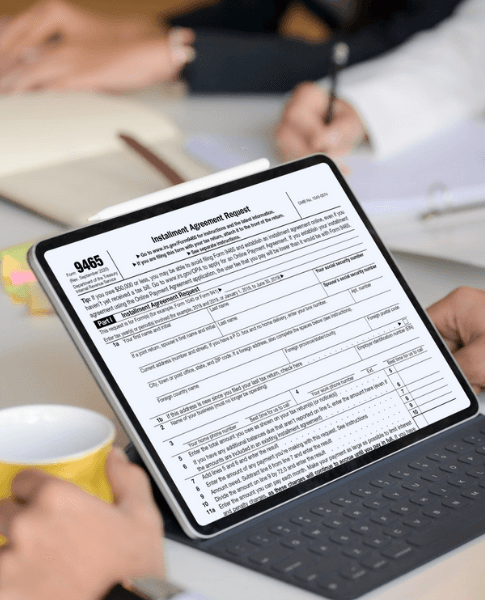
Applying for an IRS installment plan involves more than just filling out a single form. Depending on the amount you owe and the type of plan you request, you may need to submit Form 9465 (Installment Agreement Request) to request the agreement, along with a Collection Information Statement (Form 433-A, 433-B, or 433-F) to provide detailed financial information. Generally, it takes four to six weeks to finalize an installment agreement and set up the payment method. However, several factors can affect the turnaround time, including the payment method you choose and current IRS processing times. Your tax professional can guide you through the process to ensure your application is complete, accurate, and structured to fit your financial situation.

We review your income, expenses, and existing obligations to determine a plan that is realistic and manageable, helping you avoid defaulting on payments.

We prepare and submit the necessary forms, such as Form 9465 and, if needed, Form 433-A, B, or F. If required tax returns are missing, we can handle those on your behalf.

We manage all correspondence with the IRS, negotiating favorable terms and ensuring your application is approved as quickly as possible.
Our tax attorneys and licensed professionals have helped thousands of clients resolve their tax problems through installment agreements and other powerful tax assistance programs offered by the IRS. Our team will work on your behalf, fighting to get you the best possible deal with the IRS so you can put your tax problems to rest. In addition to IRS installment agreements, our team can help with:
For more information on our tax relief services, we welcome you to call us for a free consultation: (800) 536-0734.
Optima Tax Relief, LLC is a tax resolution firm independent from the IRS. This content is made available for informational and educational purposes only. Nothing included in the content should be taken as a guarantee, warranty, prediction, or representation about your specific situation. This content is not intended to be a substitute for professional advice and services. We encourage you to consult with a tax professional to discuss your specific tax matters. Individual results may vary. We do not provide tax, financial, bankruptcy, accounting, or legal advice and nothing contained in this content is intended nor shall be construed as such.
Get an in-depth look at Partial Payment Installment Agreements (PPIAs), including eligibility, benefits, the application process, and more.
Read More >
Here’s an overview of how IRS installment agreements work, including eligibility criteria, application processes, types of agreements, and key considerations.
Read More >
Learn the potential repercussions of defaulting on an IRS installment agreement and the steps you can take to mitigate them.
Read More >Free consultation
Call 1-800-536-0734 for a free consultation.