
Tax and IRS NewsAuthored by Deanna Aldayyat, Content and PR Specialist
Key Takeaways
- 88% of surveyed taxpayers could not confidently say what to do about their tax problem, including 53% who did not understand their options.
- 29% said they did not believe they could afford any solution, making cost the most commonly cited reason for delaying action.
- 23% felt overwhelmed and avoided the problem, while another 23% said they did not know where to start.
- 68% knew they were out of compliance with the IRS, and another 17% suspected it, showing that awareness of a tax problem does not always lead to immediate action.
- The average taxpayer in the 2025 client population had approximately 3.6 unfiled tax years, illustrating how unresolved tax issues can persist over time.
- The Annual Report suggests that uncertainty, affordability concerns, and feeling overwhelmed can contribute to delays in resolving tax problems.
Tax problems rarely appear overnight. For many taxpayers, an unresolved tax issue can grow gradually—from a missed filing or unpaid balance into years of penalties, interest, notices, and uncertainty. But why do people wait to address these problems, even when they know something is wrong?
Optima Tax Relief’s 2025 Annual Report offers insight into that question by examining the experiences of taxpayers who enrolled as Optima clients during 2025. The report combines anonymous survey responses with aggregated, de-identified client compliance records to examine taxpayer behavior, sentiment, and IRS enforcement activity. The findings show a significant gap between knowing there is a tax problem and understanding what to do about it.
It’s important to note that the report reflects the experiences of surveyed Optima clients and Optima’s 2025 client population. These findings offer insight into people who sought professional tax relief assistance, but they should not be interpreted as representative of all taxpayers.
Why Do Taxpayers Delay Resolving Tax Problems?
Taxpayers may recognize that they have an unresolved tax issue but still struggle to determine what steps to take. The Annual Report suggests that uncertainty, cost concerns, and feeling overwhelmed can all contribute to delays.
Many Taxpayers Know They Have a Problem
Among the taxpayers surveyed for the Annual Report, 68% knew they were out of compliance with the IRS, and another 17% suspected it. However, awareness did not necessarily translate into action.
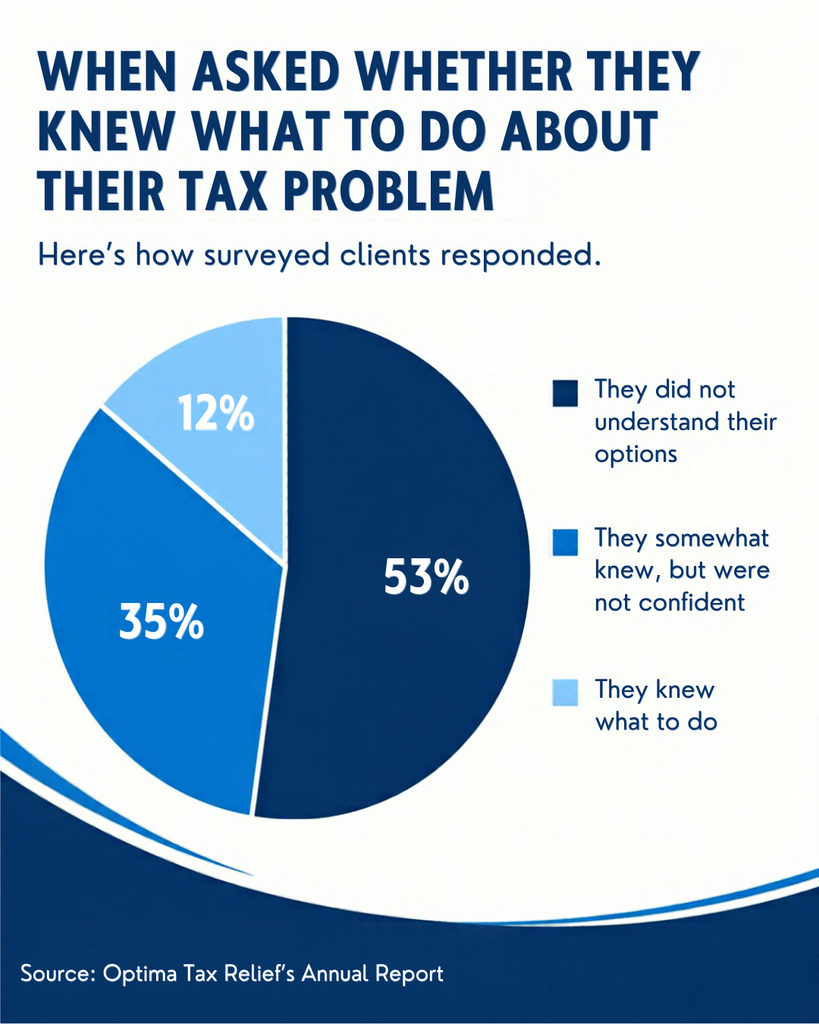
When asked whether they knew what to do about their tax problem:
- 12% said they knew what to do.
- 35% said they somewhat knew, but were not confident.
- 53% said they did not understand their options.
In other words, 88% could not confidently say what to do about their tax problem.
This distinction is important. A taxpayer can know that a return was never filed, a balance remains unpaid, or an IRS notice needs attention without knowing how to resolve the underlying issue.
For example, someone may know that they owe back taxes but not understand whether they qualify for an installment agreement, whether penalties can be reduced, whether an unfiled return needs to be submitted, or what happens if the IRS has already taken collection action.
Awareness Does Not Always Lead to Immediate Action
The report found that half of surveyed taxpayers knew they were out of compliance but delayed dealing with the problem. Another 18% said they knew they had an issue but underestimated the consequences.
An additional 17% suspected they had a problem but were not sure, while 15% did not realize they were noncompliant.
This helps explain why tax problems can persist for years. Someone may recognize a problem but postpone dealing with it because the consequences do not feel immediate.
A taxpayer who misses a filing deadline, for example, might intend to file “next month.” If the return remains unfiled, that month can become a year, and one year can become several.
What Keeps People From Addressing Tax Problems?
The reasons taxpayers delay are not limited to simply ignoring the IRS. The Annual Report identified several practical and emotional barriers that can make taking the first step difficult.
Cost Is a Major Concern
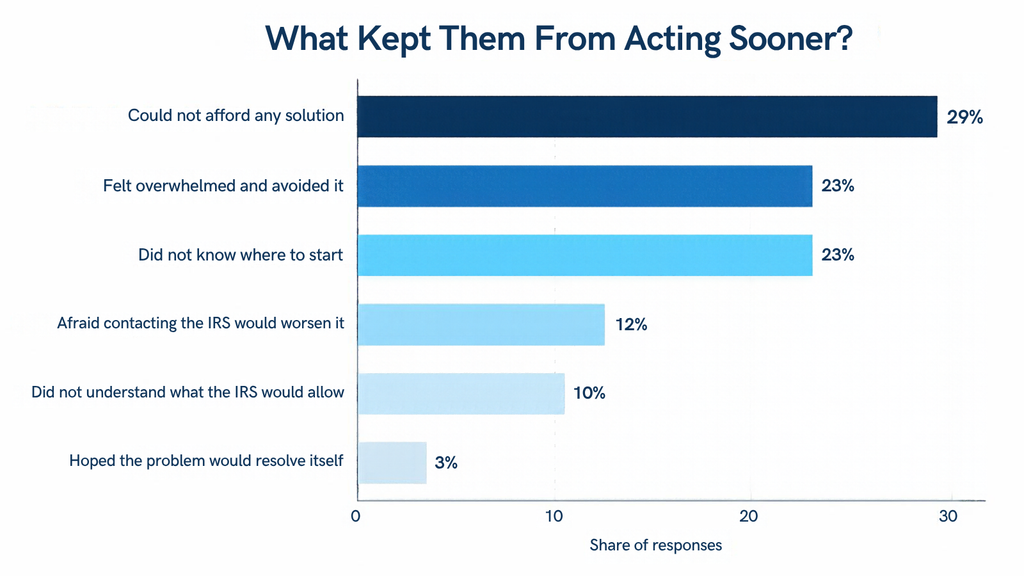
The most frequently cited reason for delaying was affordability. Twenty-nine percent of respondents said: “I didn’t believe I could afford any solution.”
This concern can become more significant as penalties and interest accumulate.
For someone already struggling financially, receiving an IRS notice showing a balance of thousands of dollars can create the perception that the situation is impossible to resolve. That perception may lead to further delays, even though the IRS offers several payment and resolution options depending on a taxpayer’s circumstances.
The important point is that taxpayers should not automatically assume that the amount shown on an IRS notice represents the only possible path forward. Eligibility for specific IRS programs depends on factors such as income, expenses, assets, filing history, and ability to pay.
The report also highlights affordability as a potential opportunity for earlier intervention. When asked what could have helped them address their situation, 32% of surveyed clients identified affordable early-stage help. This finding connects with the 29% who said they did not believe they could afford any solution, suggesting that cost concerns can prevent people from seeking help before their tax problems become more complicated.
Feeling Overwhelmed Can Become a Barrier
Twenty-three percent of surveyed taxpayers said they felt overwhelmed and avoided the problem. Another 23% said they did not know where to start.
These findings point to a common problem with unresolved tax issues: complexity can create inaction.
Consider a taxpayer who has several years of unfiled returns, an outstanding balance, and multiple IRS notices. The taxpayer may know that filing the missing returns is important but has no idea which year to address first, what documents are needed, or how filing the returns could affect the existing balance.
When a problem becomes complicated enough, avoiding it can temporarily feel easier than confronting it.
Fear Can Also Keep Taxpayers From Acting
Twelve percent of respondents said they were afraid contacting the IRS would make the situation worse, while 10% said they did not understand what the IRS would allow.
Fear can also affect taxpayers before they even begin filing. The report found that 32% identified fear of how much they might owe as the top reason filing felt impossible. This suggests that uncertainty about the potential financial consequences of filing can become a barrier before a taxpayer takes steps to understand their actual liability.
This illustrates another important distinction: fear of the IRS and uncertainty about the IRS are not necessarily the same thing.
Some taxpayers may worry that contacting the IRS will immediately trigger aggressive collection activity. Others may simply be unfamiliar with the agency’s procedures and available options.
Taxpayers facing an IRS problem should understand what a notice says, what deadline applies, and what action is required rather than assuming that ignoring the notice will make the problem disappear. Only 3% of responses said they waited, hoping the problem would resolve itself. Cost (29%), feeling overwhelmed (23%), and not knowing where to start (23%) together made up 75% of responses.
What Might Help Taxpayers Act Earlier?
The report’s findings also point to ways taxpayers could be better equipped to address tax problems before they grow. In addition to the 32% who identified affordable early-stage help, 16% said knowing that filing is required even if they cannot pay would have helped them address their situation.
This finding highlights an important distinction between filing a tax return and paying the balance due. Taxpayers who cannot afford to pay their full tax liability should not automatically assume they should delay filing. Filing requirements still apply even when a taxpayer cannot pay in full, and understanding that distinction may help some people take the first step toward addressing an unresolved tax issue.
What Finally Motivates Taxpayers to Act?
If taxpayers delay because of cost, confusion, or fear, what eventually causes them to take action?
The Annual Report found that the most common triggers were often internal realizations rather than direct enforcement.
Waiting Starts to Feel More Expensive
Twenty-nine percent of selections cited realizing that waiting was making the problem worse. Another 19% of selections cited a balance that had grown beyond what they could ignore. Respondents could select up to two answers, so percentages show each answer’s share of all selections.
That pattern makes sense because tax liabilities can continue to grow through penalties and interest. A taxpayer who postpones addressing a balance may eventually find that the amount is significantly larger than it was when the problem began.
The lesson is straightforward: delaying a tax problem does not necessarily keep the problem from growing.
Fear of Collection Can Become a Turning Point
Twenty-one percent of selections cited fear of garnishment or levy. Another 15% cited an IRS enforcement notice or deadline.
IRS collection actions can include balance due notices, levies, and federal tax liens. The specific consequences depend on the taxpayer’s circumstances and the stage of the collection process.
For taxpayers receiving IRS notices, understanding what the notice means and responding by the stated deadline can be important.
How Long Do Tax Problems Last?
The report’s client compliance records show that many tax problems persist for years rather than months.
The Average Taxpayer Had Multiple Unfiled Tax Years
Among the 2025 client population, the average taxpayer had approximately 3.6 unfiled tax years.
Approximately 30% had six or more unfiled years, while about 13% had zero unfiled years. The median total accrued balance was approximately $19,000, while the average total accrued balance was approximately $38,000.
The report also found that the average time since the first balance-due year was approximately 5.8 years, with a median of approximately five years.
These numbers demonstrate how quickly an unresolved tax issue can become a long-term problem.
Why Filing Missing Returns Matters
A taxpayer who has unfiled returns may face challenges beyond the immediate filing requirement. The IRS may not have a complete picture of the taxpayer’s financial situation until required returns are filed.
Beyond the report’s client data, general IRS procedures provide additional context for why filing missing returns matters. In some situations, the IRS can also prepare a Substitute for Return when a taxpayer fails to file. That process can result in an assessment based on information available to the IRS rather than the deductions and credits a taxpayer may have been entitled to claim on an accurately prepared return.
That is one reason taxpayers with multiple unfiled returns should not assume that ignoring the issue will make it go away. About 12% of Optima’s 2025 clients had a Substitute for Return filed by the IRS on record, according to the report’s account records. A Substitute for Return uses only income reported by third parties and applies no deductions or credits.
Did Most Taxpayers Try to Resolve Their Problems With the IRS?
The Annual Report found that many taxpayers sought professional assistance without first attempting to resolve the matter directly with the IRS.
Seventy Percent Did Not Try to Resolve the Issue With the IRS First
When asked whether they had tried resolving their tax issue directly with the IRS before seeking professional help, 30% said yes and 70% said no.
This does not necessarily mean taxpayers were unwilling to communicate with the IRS. It may instead reflect uncertainty about how to navigate the tax resolution process.
Among those who sought professional assistance, 38% said they wanted the best possible outcome, 24% did not trust themselves to handle the IRS correctly, and 14% found IRS rules and notices too confusing.
Only 5% identified fear of IRS enforcement as the reason they sought professional help.
The findings suggest that professional assistance is not always about avoiding the IRS. For many taxpayers, it is about understanding a complicated situation and determining what options may be available.
What Can Taxpayers Do When They Have an Unresolved Tax Problem?
Although every tax situation is different, taxpayers can take several practical steps when dealing with back taxes or unfiled returns.
Start by Understanding the Problem
Before deciding how to resolve a tax liability, determine what is actually owed and why. That may mean reviewing IRS notices, identifying unfiled tax years, checking account transcripts, gathering income documentation, and determining whether returns were filed correctly.
A taxpayer cannot make an informed decision about payment or resolution options without understanding the underlying tax situation.
Don’t Ignore IRS Notices
An IRS notice generally explains why the taxpayer is being contacted and what action the IRS expects.
Ignoring a notice does not eliminate the underlying liability. Depending on the situation, failure to respond can allow collection activity to continue.
Taxpayers should pay particular attention to response deadlines and the specific instructions contained in each notice.
Explore Available Resolution Options
Depending on their circumstances, taxpayers may qualify for options such as an installment agreement, an Offer in Compromise, penalty relief, or other collection alternatives.
Eligibility is based on the taxpayer’s individual financial and tax circumstances. There is no single tax relief option that works for everyone.
Taxpayers who are unsure how to proceed can consider consulting a qualified tax professional who can review their circumstances and explain potential options.
Frequently Asked Questions About Delaying Tax Problems
Why do people delay paying back taxes?
The Annual Report found that cost, feeling overwhelmed, and not knowing where to start were among the most common reasons taxpayers delayed addressing their tax problems. Some taxpayers also feared contacting the IRS or did not understand what the IRS would allow.
Does ignoring the IRS make a tax problem go away?
Generally, ignoring an IRS notice does not resolve the underlying tax issue. Depending on the circumstances, penalties, interest, and collection activity may continue.
What happens if I have several years of unfiled tax returns?
The IRS may take steps to determine a taxpayer’s liability, including using its Substitute for Return process in qualifying situations. Filing delinquent returns can allow the taxpayer’s actual income, deductions, and credits to be considered.
Can tax debt be reduced?
In certain circumstances, taxpayers may qualify for programs that reduce or otherwise resolve a tax liability. Eligibility depends on factors including income, expenses, assets, filing compliance, and the taxpayer’s overall financial situation.
When should I seek help with a tax problem?
There is no universal point at which every taxpayer needs professional assistance. However, taxpayers who have multiple unfiled returns, large or disputed balances, collection notices, or uncertainty about their options may benefit from understanding their situation sooner rather than later.
Conclusion
The findings in Optima Tax Relief’s 2025 Annual Report show that many taxpayers do not delay addressing tax problems because they simply do not care about them. Instead, the reasons are often more complicated.
Among the surveyed clients, 68% knew they were out of compliance, yet 88% could not confidently say what to do about their tax problem. Cost, uncertainty, feeling overwhelmed, and fear all contributed to delays.
The report also highlights the potential value of earlier guidance. Thirty-two percent of surveyed clients said affordable early-stage help could have helped them address their situation, while 16% identified knowing that filing is required even if they cannot pay. These findings reinforce how affordability and uncertainty can stand in the way of taking action.
The report also shows that waiting can turn a relatively manageable tax issue into a much more complicated one. The average taxpayer in the client population had approximately 3.6 unfiled tax years and had been carrying a balance-due issue for approximately 5.8 years.
The takeaway for taxpayers is simple: if you have an unresolved tax problem, understanding your options early can be more productive than waiting for the problem to become more serious.
Optima Tax Relief’s Annual Report provides a closer look at why taxpayers delay and what ultimately motivates them to act. In the report, 82% of surveyed clients said their situation was preventable, while 18% said it was unavoidable. For taxpayers facing their own unresolved tax issues, the first step is understanding what they owe, what remains unfiled, and what options may be available for resolving the situation.
If You Need Tax Help, Contact Us Today for a Free Consultation.
This content is made available for informational and educational purposes only. Nothing included should be taken as a guarantee, warranty, prediction, or representation about your specific situation. This content is not intended to be a substitute for professional advice. We encourage you to consult with a tax professional to discuss your specific tax matters. Individual results may vary. Optima Tax Relief does not provide tax, financial, bankruptcy, accounting, or legal advice.
Results were obtained from an anonymous survey of 374 Optima clients conducted from 5/5/26-6/30/26