
Tax and IRS NewsAuthored by Deanna Aldayyat, Content and PR Specialist
Key Takeaways
- 29% of selections cited realizing that waiting was making the problem worse, making it the most common reported trigger.
- 21% of selections cited fear of garnishment or levy, while 19% cited a balance that grew beyond what they could ignore.
- 15% of selections cited an IRS enforcement notice or deadline, showing how direct communication can create urgency.
- Before seeking help, 70% had never tried resolving their tax problem directly with the IRS.
- Among those who sought professional help, 38% wanted the best possible outcome, while 24% said they did not trust themselves to handle the IRS correctly.
- The report found that 68% knew they were out of compliance, but 88% could not confidently say what to do about their tax problem, highlighting the gap between awareness and action.
Knowing you have a tax problem and deciding to do something about it are not always the same thing. A taxpayer may know a return was never filed. They may know an IRS balance remains unpaid. They may even suspect that penalties and interest are accumulating. Yet months—or years—can pass before they finally take action.
Optima Tax Relief’s 2025 Annual Report provides insight into what eventually changes that calculation.
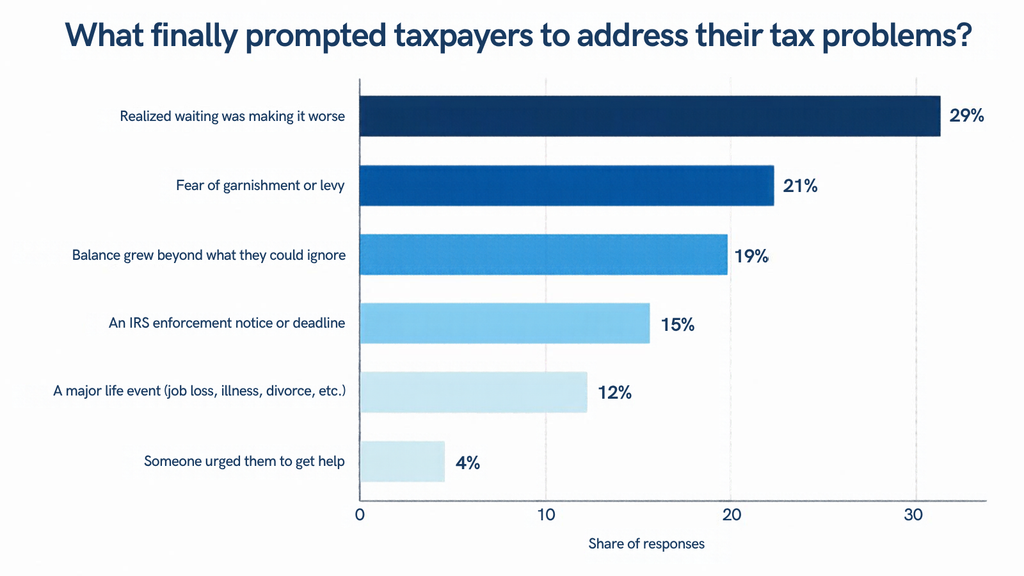
Among surveyed taxpayers, the most common trigger for finally addressing a tax problem was realizing that waiting was making the problem worse. Twenty-nine percent of selections cited that realization. Respondents could select up to two answers, so percentages show each answer’s share of all selections. Other taxpayers were motivated by a growing balance, fear of garnishment or levy, or an IRS enforcement notice or deadline. Major life events and encouragement from another person also played a role.
The findings reveal an important pattern: taxpayers often do not act when they first discover a problem. They act when the cost of continuing to wait becomes impossible to ignore.
These findings reflect responses from clients who enrolled in Optima Tax Relief’s resolution services during 2025. They offer insight into the experiences of this client population but should not be interpreted as representative of all U.S. taxpayers.
Why Do Taxpayers Wait?
Before understanding what makes taxpayers act, it helps to understand why they delay in the first place.
Knowing About a Problem Does Not Mean Knowing How to Fix It
Optima’s Annual Report found that 68% of surveyed taxpayers knew they were out of compliance with the IRS, and another 17% suspected it.
But 88% could not confidently say what to do about their tax problem.
Only 12% said they knew what to do, while 35% said they somewhat knew but were not confident. Another 53% said they did not understand their options. That creates a difficult situation.
A taxpayer can know that something is wrong without knowing what the correct next step should be.
Cost Can Make Action Feel Impossible
Twenty-nine percent of surveyed taxpayers said: “I didn’t believe I could afford any solution.”
This is understandable for someone facing a large IRS balance. A taxpayer who owes thousands of dollars may assume that the only acceptable response is to pay the entire balance immediately. If that is financially impossible, the taxpayer may conclude that there is nothing they can do.
But filing and paying are separate issues, and the IRS offers different collection and payment options depending on a taxpayer’s circumstances.
Feeling Overwhelmed Can Lead to Avoidance
Twenty-three percent of respondents said they felt overwhelmed and avoided the problem. Another 23% said they did not know where to start. Tax problems can become particularly intimidating when they involve multiple years.
The Annual Report found that the average taxpayer in the client population had approximately 3.6 unfiled tax years.
For someone facing several years of missing returns and an IRS balance, the question may not be “Should I fix this?” It may be: “Where do I even begin?”
The emotional state of taxpayers seeking help provides additional context. More than half described themselves as overwhelmed (36%), panicked (11%), or defeated (5%), while 33% said they were ready to fix the problem. These responses suggest that taxpayers can arrive at the point of seeking help with very different levels of distress and readiness to act.
What Finally Causes Taxpayers to Act?
The Annual Report identifies several moments that can change a taxpayer’s behavior.
The Biggest Trigger: Realizing Waiting Is Making Things Worse
Twenty-nine percent of selections cited realizing that waiting was making the problem worse. That was the most frequently cited trigger. The realization can happen gradually.
For illustration, a taxpayer may initially think a $5,000 balance is manageable. Then penalties and interest accumulate. Another notice arrives. The balance grows. The taxpayer realizes the problem has not stayed the same.
At that point, continuing to wait may feel riskier than addressing the problem.
This internal realization was cited nearly twice as often as receiving an IRS enforcement notice or deadline, which accounted for 15% of selections. The difference suggests that a taxpayer’s own assessment of a worsening situation may be a more common turning point than a direct external prompt.
The time it takes to reach that point can also be significant. The report found that surveyed clients had waited approximately 5.8 years, on average, before addressing their tax problems. This highlights that the decision to act may come long after a taxpayer first recognizes an issue.
A Growing Balance Can Become the Breaking Point
Nineteen percent of selections cited a balance that had grown beyond what they could ignore. This is different from simply being unable to pay.
A taxpayer may have been aware of a balance for years but mentally treated it as a future problem. As the amount grows, the issue becomes harder to compartmentalize.
As a hypothetical example, someone who originally owed $8,000 may be much more motivated to investigate the situation after discovering that the balance has grown significantly due to penalties and interest.
The precise amount a taxpayer owes depends on the underlying liability and applicable penalties and interest, but the behavioral pattern is clear: a growing balance can turn a distant concern into an immediate priority.
Fear of Garnishment or Levy Can Create Urgency
Twenty-one percent of selections cited fear of garnishment or levy. This is an important distinction. Taxpayers may tolerate an unpaid balance when the consequences feel abstract. A potential levy or wage garnishment can make the consequences feel immediate.
An IRS levy can involve the seizure of property or rights to property to satisfy a tax debt. An IRS wage levy, often called wage garnishment, requires an employer to send part of each paycheck to the IRS. Receiving a notice warning about potential collection action can therefore become a major turning point.
An IRS Notice or Deadline Can Force a Decision
Fifteen percent of selections cited an IRS enforcement notice or deadline. This illustrates how deadlines can change behavior.
A taxpayer may postpone addressing an issue indefinitely until a notice provides a specific date by which action is required. That is one reason IRS notices should be opened and reviewed promptly.
A Major Life Event Can Change Priorities
Twelve percent of selections cited a major life event, such as job loss, illness, or divorce. These events can change a taxpayer’s financial circumstances, available time, or priorities, prompting them to revisit a tax problem they had previously put off.
Another 4% of selections cited someone urging them to act. Although this was the least frequently cited of these triggers, it shows that encouragement from another person can also play a role in moving a taxpayer toward a decision.
Why Does Waiting Feel Easier Than Acting?
The Annual Report’s findings suggest that delay is often about uncertainty rather than indifference.
Tax Problems Can Create an Avoidance Cycle
The following is an illustrative framework for how avoidance can develop; it is not a specific model measured by the Annual Report.
A common cycle can look like this:
Problem → uncertainty → avoidance → additional time passes → consequences grow → greater stress → eventual action.
For example, a taxpayer receives an IRS notice but does not understand it. They put it aside. Another notice arrives. They are now even more worried because they have not responded to the first one. The taxpayer may feel overwhelmed and continue avoiding the issue.
Eventually, the balance grows or the IRS threatens collection action, creating enough urgency to finally seek help.
Breaking that cycle earlier can prevent a tax problem from becoming more complicated.
Fear Does Not Always Lead to Immediate Action
Interestingly, fear of the IRS was not the dominant reason surveyed taxpayers ultimately sought professional help. Only 5% said they sought professional help because they were afraid of IRS enforcement.
By comparison, 38% said they wanted the best possible outcome, 24% did not trust themselves to handle the IRS correctly, and 14% found IRS rules and notices too confusing. That suggests the decision to act is often about wanting clarity and control, not simply fear.
These figures address a different question from the survey’s findings on what triggered taxpayers to act. Fear of garnishment or levy accounted for 21% of trigger selections, while fear of IRS enforcement accounted for 5% of reasons for seeking professional help. One measures what prompted action; the other measures why people sought professional assistance. The findings are therefore not necessarily contradictory.
What Happens When Taxpayers Finally Decide to Act?
Once a taxpayer makes the decision to address a tax problem, the next challenge is determining what needs to happen.
Start With Filing Compliance
For taxpayers with unfiled returns, determining which years are missing is an important first step. The Annual Report found that the average taxpayer in the 2025 client population had approximately 3.6 unfiled tax years.
Multiple missing returns can complicate the process because the taxpayer may need to reconstruct financial records from several years. Unfiled returns can also block relief. The IRS will not consider an Offer in Compromise until all required returns are filed. The report also discusses a specific TIGTA finding involving high-income non-filers, including cases in which taxpayers flagged through that initiative faced restrictions on installment agreements and Offers in Compromise. That finding relates to the particular non-filer initiative and should not be taken to mean that every taxpayer with an unfiled return is automatically locked out of these options. Filing requirements should be evaluated for each relevant tax year.
Determine the Actual Balance
The amount a taxpayer believes they owe may not always match the IRS’s current account information.
Taxpayers should determine:
- Which tax years have balances.
- Whether all required returns have been filed.
- What penalties have been assessed.
- How much interest has accrued.
- Whether previous payments have been credited.
- Whether an IRS-generated assessment is involved.
Understanding the actual problem makes it easier to evaluate potential solutions.
Determine What the Taxpayer Can Afford
A taxpayer who cannot pay the entire balance should not automatically conclude that the situation is hopeless.
The IRS has payment arrangements and other collection options for taxpayers who meet applicable requirements. The appropriate option depends on the taxpayer’s financial situation and tax history.
What If the Taxpayer Has Already Received an IRS Collection Notice?
A collection notice can be the moment when a taxpayer realizes that waiting is no longer an option.
Different Notices Can Signal Different Stages
The Annual Report cites millions of automated collection notices in FY2025 (annualized figures).
These included:
- CP14 initial balance-due notices.
- CP501 first reminders.
- CP503 second reminders.
- CP504 final notices involving intent to levy.
- CP523 notices involving defaulted installment agreements.
Each type of notice has a different purpose.
Taxpayers should not assume that receiving any IRS notice means the same thing. The specific notice should be reviewed carefully for the balance, tax year, response deadline, and potential next steps.
A Notice Can Be an Opportunity to Act
An IRS notice may be intimidating, but it can also provide valuable information. It tells the taxpayer what the IRS believes is owed, what action the agency expects, and what may happen next. That information can help a taxpayer move from uncertainty to a concrete plan.
What If the Taxpayer Cannot Afford to Pay?
This is one of the most important questions for anyone considering whether to address a tax liability.
Filing and Paying Are Not the Same Thing
A taxpayer can have a filing obligation even when they cannot afford to pay the resulting tax liability in full. Failing to file because of an inability to pay can create additional complications.
Taxpayers should determine whether returns need to be filed and then evaluate their payment or collection options separately.
Payment Options Depend on Individual Circumstances
Some taxpayers may qualify for installment agreements or other IRS collection alternatives. In certain situations, taxpayers may also qualify for an Offer in Compromise or penalty relief. However, eligibility is not automatic. The IRS considers specific requirements when determining whether a taxpayer qualifies for a particular program.
Can Getting Help Make It Easier to Act?
For some taxpayers, professional assistance can reduce uncertainty.
Many Taxpayers Said They Wanted the Best Possible Outcome
Among surveyed taxpayers who sought professional help:
- 38% wanted the best possible outcome.
- 24% did not trust themselves to handle the IRS correctly.
- 14% found IRS rules and notices too confusing.
- 12% wanted someone else to deal with the IRS.
- 5% were afraid of IRS enforcement.
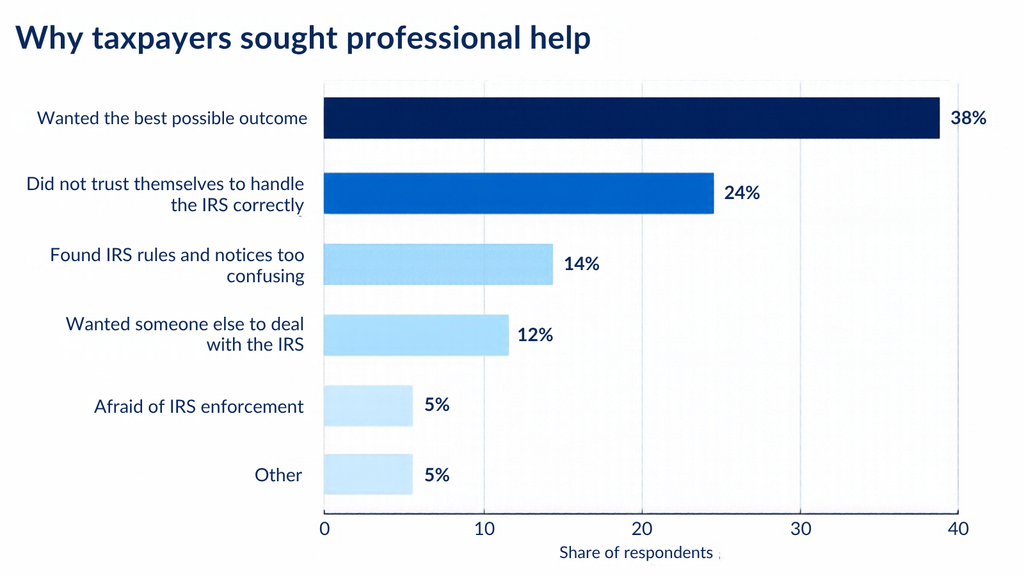
The results show that seeking assistance is not necessarily about avoiding responsibility. For many taxpayers, it is about having someone help them understand a complicated process and identify potential options.
The Earlier a Problem Is Understood, the More Options May Be Available
There is no universal rule that every taxpayer should immediately hire professional help. But taxpayers generally benefit from understanding their situation sooner rather than later. A taxpayer who identifies a missing return early may have more time to gather records.
Someone who receives an initial balance-due notice may have more time to consider payment options than someone who waits until collection activity becomes more serious. The earlier the problem is understood, the less likely the taxpayer is to be making decisions under unnecessary pressure.
What Can Taxpayers Do Today If They Have Been Waiting?
For someone who has been postponing a tax problem, the first step does not have to be solving everything at once. Taking a smaller, specific action can make the situation feel more manageable and help a taxpayer understand what needs to happen next.
Start With One Question
The first step is to identify exactly what remains unresolved. A tax problem could involve an unfiled return, an unpaid tax liability, an IRS notice, a disputed assessment, or a collection action. In some cases, several of these issues may exist at the same time.
Clearly defining the problem can make it easier to determine what information is needed and which options may be available. Instead of approaching the situation as one large, complicated problem, a taxpayer can begin by identifying the specific issue that needs attention first.
Gather the Information
Once the issue has been identified, gathering the relevant tax records and IRS correspondence can provide a clearer picture of the situation. Taxpayers with unfiled returns should determine which years are missing, while those with an unpaid balance should review the current amount owed and any applicable notices.
Documentation is also important if a taxpayer believes the IRS has made an error or does not agree with an assessment. Having the appropriate tax returns, financial records, notices, and supporting documents available can make it easier to understand the issue and determine the appropriate next step.
Take the Next Concrete Step
The goal does not have to be to solve an entire tax problem in one day. For someone who has been waiting to address an unresolved issue, taking one concrete step can be enough to begin moving forward.
That step might include:
- Requesting necessary tax or IRS records.
- Preparing a missing tax return.
- Reviewing an IRS notice and its response deadline.
- Verifying the current account balance.
- Contacting the IRS about the issue.
- Consulting a qualified tax professional.
- Researching potential tax resolution or payment options.
Taking action does not necessarily mean committing to a particular solution. It can simply mean replacing uncertainty with information. Once a taxpayer understands what is owed, what the IRS is requesting, and what options may be available, the situation can become easier to address.
Frequently Asked Questions About Resolving Tax Problems
Why do taxpayers wait to resolve tax problems?
The Annual Report identified several reasons, including affordability concerns, feeling overwhelmed, not knowing where to start, fear of contacting the IRS, and uncertainty about available options.
What makes taxpayers finally address tax problems?
The most common reason identified in the Annual Report was realizing that waiting was making the problem worse. Other triggers included a growing balance, fear of garnishment or levy, and an IRS enforcement notice or deadline.
What percentage of taxpayers said waiting made the problem worse?
Twenty-nine percent of selections cited realizing that waiting was making the problem worse.
Can a tax balance grow if I do nothing?
Depending on the circumstances, penalties and interest can continue to accrue on unpaid tax liabilities. The specific amount depends on the taxpayer’s account and applicable IRS rules.
What if I cannot afford to pay my IRS balance?
A taxpayer who cannot pay the full balance should determine whether they qualify for an installment agreement or another IRS collection option. Eligibility depends on individual circumstances.
Should I file my tax return if I cannot pay the tax?
Filing and paying are separate obligations. A taxpayer who has a filing requirement generally should not assume that an inability to pay means the return should remain unfiled.
Is it too late to address an old tax problem?
Not necessarily. The appropriate response depends on the age and nature of the tax problem, whether returns were filed, the status of the IRS account, and whether collection actions are involved.
Conclusion
The decision to finally address a tax problem often does not happen when the problem first appears. It happens when something changes.
For 29% of selections in Optima Tax Relief’s 2025 Annual Report survey, that change was realizing that waiting was making the problem worse. For others, it was a growing balance, fear of garnishment or levy, or an IRS enforcement notice or deadline. These findings reveal that delay is not always a sign that taxpayers do not care about their tax obligations.
The report also shows how long that delay can last: surveyed clients had waited approximately 5.8 years, on average, before addressing their tax problems. Many arrived feeling overwhelmed, panicked, or defeated, while others were ready to fix the issue. Their experiences illustrate that the path to action can involve both emotional strain and a practical reassessment of the situation.
Often, taxpayers are uncertain about what to do, worried about the cost, overwhelmed by the process, or simply unsure where to begin. But waiting can make an unresolved tax issue more complicated.
For taxpayers who have been putting off a tax problem, the first step does not have to be solving everything at once. It can simply be understanding what is unresolved, gathering the necessary information, and determining what needs to happen next.
The decision to act may be difficult. But the data suggests that for many taxpayers, the most important realization is also the simplest: waiting is a decision, too.
If You Need Tax Help, Contact Us Today for a Free Consultation.
This content is made available for informational and educational purposes only. Nothing included should be taken as a guarantee, warranty, prediction, or representation about your specific situation. This content is not intended to be a substitute for professional advice. We encourage you to consult with a tax professional to discuss your specific tax matters. Individual results may vary. Optima Tax Relief does not provide tax, financial, bankruptcy, accounting, or legal advice.
Results were obtained from an anonymous survey of 374 Optima clients conducted from 5/5/26-6/30/26