
Tax and IRS NewsAuthored by Deanna Aldayyat, Content and PR Specialist
Key Takeaways
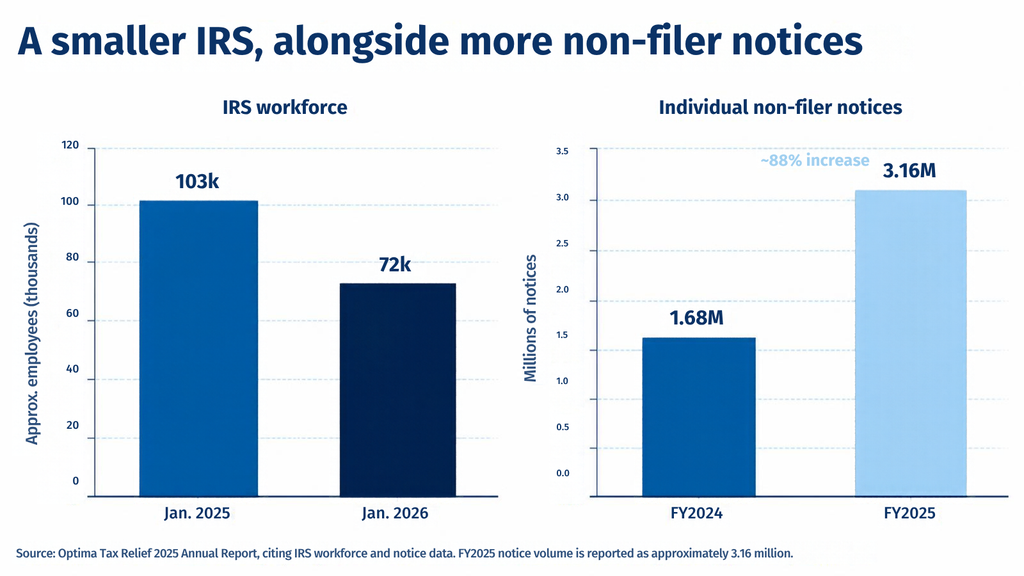
- The IRS lost roughly 30% of its workforce between January 2025 and January 2026, with 31,273 separations taking headcount from approximately 103,000 to 72,000.
- IRS Collection staff declined 41% between FY2024 and January 2026, while Appeals revenue fell 71% over three years.
- After automated collection notices restarted in February 2024, millions of notices were issued in FY2025, including approximately 13.3 million CP14 initial balance due notices (annualized).
- Individual non-filer notices reached 3.16 million in FY2025 after the program resumed, compared with 1.68 million in FY2024.
- The IRS’s Automated Substitute for Return (ASFR) program closed 592,800 cases in FY2025, up 135% from FY2023, and generated $2.9 billion in additional assessments.
- Cases closed after taxpayer contact rose 271% from FY2023 to FY2025, to 161,900, while 430,900 FY2025 cases (about 73%) closed without any taxpayer contact.
The IRS looks different than it did just a few years ago. Its workforce has contracted, enforcement resources have changed, and some traditional enforcement functions have become less visible. For taxpayers, that may create the impression that the IRS is watching less closely. But the data tells a more complicated story.
Data compiled in Optima Tax Relief’s 2025 Annual Report, drawing on government sources including Treasury Inspector General for Tax Administration (TIGTA) audits and the IRS Data Book, shows that the IRS workforce fell by roughly 30% between January 2025 and January 2026. Collection staffing was down 41% from FY2024, while enforcement revenue from several traditional functions declined. At the same time, automated collection notices and programs designed to identify non-filers and unpaid tax liabilities resumed or expanded after periods of interruption.
In other words, enforcement got quieter. Belief in it got quieter too. The notices didn’t.
The IRS Became Smaller and Less Visible
The changing size of the IRS is an important part of the enforcement story. Fewer employees can mean fewer visible interactions between taxpayers and the agency, even when automated systems continue operating.
IRS Staffing Fell Significantly
According to government workforce data cited in Optima Tax Relief’s Annual Report, the IRS lost roughly 30% of its workforce between January 2025 and January 2026. The report cites 31,273 separations, taking total employees from approximately 103,000 to approximately 72,000.
The reduction affected collection functions in particular.
The report cites:
- A 46% reduction in Automated Collection System tax examiners.
- A 40% reduction in Field Collection employees.
- A 37% reduction in Campus Support Collection Operations tax examiners.
- A 41% decline in Collection staff between FY2024 and January 2026.
These reductions can change how taxpayers experience IRS enforcement.
A taxpayer who once might have interacted with an IRS employee may instead encounter a largely automated process. That can make enforcement feel quieter, even when the taxpayer’s account continues moving through the system.
Traditional Enforcement Revenue Also Changed
The Annual Report found that Appeals revenue declined 71% over three years, while Examination revenue fell 35% year over year in FY2025.
At the same time, Collection accounted for 87% of IRS enforcement revenue in FY2025, compared with 81% in FY2023. The report credits the Collection gain to the IRS restarting automated collection notices in February 2024.
However, declining revenue in some traditional enforcement functions does not tell the whole story. Total IRS enforcement revenue increased 9% over three years, suggesting that enforcement activity and revenue collection did not decline uniformly across the agency.
Revenue per employee also increased sharply in some collection functions. Field Collection revenue per employee doubled, while revenue per employee in the Automated Collection System increased 88%. These figures suggest that, even with fewer employees, some enforcement functions were generating more revenue per employee. They do not necessarily mean every function became more effective, but they complicate the idea that a smaller IRS automatically means weaker collection activity.
Funding changes add another layer to the picture. The Inflation Reduction Act provided additional funding for IRS modernization and enforcement, but the report notes that the remaining enforcement funding was exhausted on December 31, 2025. The Congressional Budget Office (CBO) also projected a 29% decline in IRS spending and estimated that the funding changes would reduce revenue by $38.6 billion. These projections provide important context for understanding the agency’s resources and future enforcement capacity.
The result is not a simple story of enforcement disappearing. Instead, the data suggests a shift in where enforcement activity and revenue are concentrated.
Millions of Notices Were Issued After Collection Notices Restarted
Although the IRS workforce became smaller, automated collection notices resumed and reached taxpayers in significant numbers during FY2025.
Automated Collection Notices Remained a Major Enforcement Tool
The Annual Report cites millions of automated notices in FY2025 (annualized figures), including approximately:
- 13.3 million CP14 initial balance-due notices.
- 12.3 million CP521 installment agreement reminders.
- 8.5 million CP504 notices of intent to levy.
- 5.8 million CP503 second reminders.
- 4.2 million CP501 first reminders.
- 2.7 million CP523 installment agreement default notices.
The IRS also issued approximately 339,000 notices of levy and filed more than 214,000 federal tax liens during FY2025. Liens and levies remain far less common than notices. The report notes that both rose year over year but are still a small fraction of the notices sent.
The numbers illustrate the central tension in today’s enforcement environment: the IRS may have fewer employees, but taxpayers can still encounter substantial automated enforcement activity.
A Notice Does Not Mean the IRS Has Forgotten About You
It can be tempting for taxpayers to interpret a period of silence as a sign that an IRS issue is no longer active. That can be risky.
An IRS account can continue to exist even when a taxpayer has not recently spoken with an IRS employee. Automated systems can generate notices, update account information, and move cases through established collection processes.
A taxpayer who has not heard from the IRS in months should not automatically assume that an outstanding balance has disappeared.
Non-filer Enforcement Also Resumed at Higher Volumes
The Annual Report provides another example of how enforcement can become less visible while remaining active.
Individual Non-filer Notices Returned After an Interruption
Individual non-filer notices reached approximately 3.16 million in FY2025, compared with 1.68 million in FY2024. Because the report records zero notices in FY2023, this pattern is better understood in the context of the program’s restart in 2024 rather than as a straightforward year-over-year growth trend from a continuous baseline.
The report also found that 93% of FY2025 individual non-filer notice volume targeted tax year 2023. This concentration shows that the resumed program was largely focused on a specific recent tax year, rather than distributing notices evenly across all potentially unfiled years.
A non-filer notice generally means the IRS’s records indicate that a taxpayer may have failed to file a required return.
The return of these notices is significant because identifying non-filers does not require an IRS employee to manually review every taxpayer account. Automated systems can compare information reported to the IRS against filed returns and identify accounts that may require follow-up.
The IRS Can Take Action Even When a Taxpayer Does Nothing
For certain non-filers, the IRS can use its Automated Substitute for Return program. The ASFR program can use information reported by third parties and other information available to the IRS to calculate a tax liability for qualifying non-filers.
Optima’s Annual Report found that the program closed 592,800 cases in FY2025, a 135% increase from FY2023. Part of that increase reflects a backlog clearing: the program was paused on and off from 2020 and was not fully restarted until May 2024. The program generated $2.9 billion in additional assessments.
The report also found that cases closed after taxpayer contact increased 271% from FY2023 to FY2025, reaching 161,900 cases. This is an important distinction because it shows that the program was not only processing cases without direct interaction. A growing number of cases were also being closed after taxpayers made contact.
However, taxpayer contact was not the outcome in most FY2025 closures. Approximately 430,900 cases, or about 73% of the total, closed without any taxpayer contact. Together, these figures illustrate how the ASFR program can process substantial case volumes through automated procedures while also resolving some cases after taxpayers engage with the IRS.
That is another reason taxpayers should not assume that a lack of personal contact means an account is inactive.
Why Might Taxpayers Feel Like Nobody Is Watching?
The Annual Report’s survey data provides an important counterpoint to the enforcement numbers.
More Than Half Were Uncertain About IRS Enforcement
When surveyed about whether the IRS finds and enforces against most people who owe, 49% said yes. The remaining 51% said no (11%) or were not sure (39%), with figures rounded.
These survey findings reflect the views of the Optima clients surveyed, not necessarily the views of taxpayers nationwide.
That perception is notable when viewed alongside the millions of notices and automated enforcement actions documented in the report.
A Smaller IRS Can Create a Different Perception of Risk
Tax enforcement is not always visible. A taxpayer might associate enforcement with an audit, a revenue officer, or a phone call from the IRS. If those interactions become less common, taxpayers may perceive enforcement as less active.
Automated enforcement changes that dynamic. A computer-generated notice does not necessarily feel like someone is actively reviewing a taxpayer’s account. But the consequences can still be significant.
For example, a CP504 is a notice of intent to levy. It allows the IRS to levy a state tax refund if the balance stays unpaid, and wage or bank levies generally require a later final notice with hearing rights. The notice itself is automated, but the potential consequences are real.
What Does This Mean for Someone Who Owes the IRS?
The changing enforcement environment does not mean taxpayers with unresolved balances should panic. It does mean they should pay attention.
A Quieter IRS Is Not Necessarily an Inactive IRS
A taxpayer may not receive frequent personal communication from the IRS, but automated systems can resume or continue operating, depending on the program and its status.
This is especially important for taxpayers with:
- Unpaid tax balances.
- Multiple years of unfiled returns.
- IRS collection notices.
- Defaulted installment agreements.
- Substitute for Return assessments.
- Prior levy or lien notices.
The specific consequences vary based on the taxpayer’s circumstances and the status of the account.
Notices Should Be Read, Not Ignored
Each IRS notice serves a specific purpose. An initial balance due notice is different from a notice of intent to levy. An installment agreement reminder is different from a notice indicating that an agreement has defaulted.
Taxpayers should read each notice carefully, identify the tax year and amount involved, and note any response deadline.
The Enforcement Shift May Be More About How the IRS Watches
The Annual Report’s data suggests that the question may no longer simply be whether the IRS is watching. The more useful question may be how the IRS is watching.
Automation Can Extend Enforcement Capacity
When an agency has fewer employees, automated systems can allow it to continue processing large numbers of taxpayer accounts.
That does not mean every account receives the same treatment or that every automated notice results in aggressive collection activity.
It does mean that the IRS can continue identifying potential non-filers, issuing balance-due notices, monitoring installment agreements, and moving cases through collection processes without requiring an employee to personally interact with every taxpayer.
The rise in revenue per employee in certain collection functions, along with the increase in cases closed after taxpayer contact, adds another dimension to this shift. Automation and more focused staff activity can coexist with a smaller workforce, although the data does not establish that every automated process or enforcement function has become more effective.
The Result Is a Quieter Form of Enforcement
This creates an interesting paradox. The IRS can be less visible while still reaching millions of taxpayers.
That may contribute to the gap identified in Optima’s survey: taxpayers may perceive less enforcement precisely as automated enforcement remains active.
What Should Taxpayers Do With an Unresolved IRS Problem?
The best response to an IRS problem is generally to understand the situation rather than make assumptions based on how frequently the IRS contacts you.
Determine What You Actually Owe
Taxpayers should review their IRS account and notices to determine:
- Which tax years are involved.
- Whether returns are missing.
- How much the IRS says is owed.
- Whether penalties and interest have been assessed.
- Whether collection action has been threatened.
- Whether previous payment arrangements are still active.
Respond to Notices by Their Deadlines
IRS notices generally explain what the taxpayer needs to do and when. A taxpayer who believes the information is incorrect should follow the notice’s instructions for responding or disputing the issue.
Understand Potential Resolution Options
Depending on the taxpayer’s circumstances, options may include paying the balance in full, establishing an installment agreement, requesting penalty relief when eligible, or pursuing another collection alternative. Not every taxpayer qualifies for every option.
Taxpayers with complicated cases may benefit from consulting a qualified tax professional who can review their individual circumstances.
Frequently Asked Questions About IRS Enforcement
Is the IRS still enforcing tax laws in 2026?
Yes. Although IRS staffing and some enforcement resources have declined, the IRS continues to issue notices, identify non-filers, collect unpaid taxes, and use automated compliance programs.
Does a smaller IRS mean fewer IRS notices?
Not necessarily. Optima’s Annual Report cites millions of automated IRS notices issued during FY2025, including balance-due notices, installment agreement reminders, and collection notices.
Is the IRS still collecting back taxes?
Yes. Collection remained a major component of IRS enforcement activity in FY2025, accounting for 87% of enforcement revenue according to data cited in the Annual Report.
What happens if I ignore an IRS notice?
Ignoring an IRS notice does not generally eliminate the underlying tax issue. Depending on the notice and taxpayer’s circumstances, the IRS may continue collection activity or take additional enforcement action.
Why does IRS enforcement feel quieter?
A significant decline in IRS staffing and changes in traditional enforcement functions can mean fewer visible interactions with IRS employees. At the same time, automated systems can continue issuing notices and processing cases.
Can the IRS enforce taxes without contacting me personally?
Yes. Automated notices and compliance programs can move taxpayer accounts through various stages of the collection process without direct interaction between the taxpayer and an IRS employee.
Conclusion
IRS enforcement in 2026 presents a complicated picture. The agency is smaller. Some traditional enforcement functions have become less visible. And more than half of taxpayers surveyed for Optima Tax Relief’s Annual Report either did not believe the IRS enforces against most people who owe or were unsure whether it does.
But automated collection notices and non-filer programs resumed or operated at substantial volumes. Millions of automated balance-due, collection, installment-agreement, and non-filer notices reached taxpayers in FY2025. The ASFR program closed hundreds of thousands of cases and generated billions of dollars in additional assessments.
Other figures complicate the idea of a uniformly weaker enforcement system. Total enforcement revenue increased 9% over three years, revenue per employee rose sharply in some collection functions, and cases closed after taxpayer contact increased 271% from FY2023 to FY2025. At the same time, the exhaustion of remaining Inflation Reduction Act enforcement funding and projected reductions in IRS spending point to significant resource constraints.
The takeaway is not that every taxpayer should expect aggressive enforcement. Rather, it is that a quieter IRS should not be mistaken for an inactive IRS.
For taxpayers with unresolved tax problems, the safest approach is to understand the status of the account, read IRS communications carefully, meet applicable deadlines, and determine what options may be available.
The way the IRS watches taxpayers may be changing. That does not mean taxpayers can stop paying attention.
If You Need Tax Help, Contact Us Today for a Free Consultation.
This content is made available for informational and educational purposes only. Nothing included should be taken as a guarantee, warranty, prediction, or representation about your specific situation. This content is not intended to be a substitute for professional advice. We encourage you to consult with a tax professional to discuss your specific tax matters. Individual results may vary. Optima Tax Relief does not provide tax, financial, bankruptcy, accounting, or legal advice.
Results were obtained from an anonymous survey of 374 Optima clients conducted from 5/5/26-6/30/26